|

|
Total Lunar Eclipse
|
After months of abnormally low rainfall in Southern California, suddenly in March, a series of rain storms moved in, threatening our chance to see the total lunar eclpse on the 13th. However, a (semi-)miraculous opening of the sky happened on the day of the eclipse. It's only semi-miraculous because although the early evening sky was completely clear, by the time the eclipse started, light clouds were moving in.
My original plan was to photograph the eclipse from the darker skies of the Orange County Astronomers site where my observatory is located. But my trip there the previous weekend to prep for the eclipse convinced me to ditch that idea because the short dirt road section was muddy and full of potholes due to an earlier storm with snow. It turned out to be a good idea to just shoot it from my backyard anyway because the observatory location was completely clouded over during the eclipse.
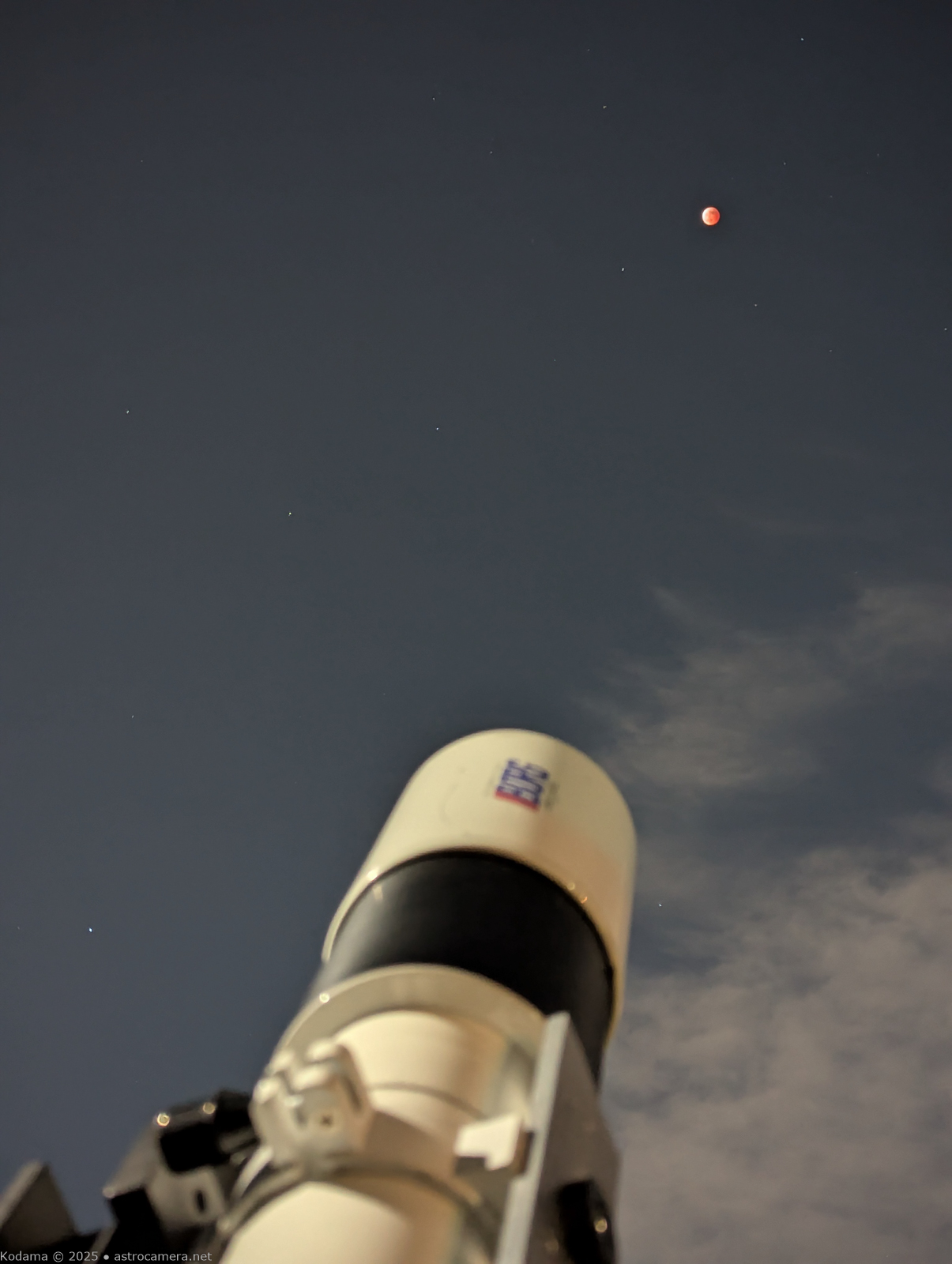
At right is a cellphone over-the-shoulder (of my telescope) shot just before the start of totality. I found that I could get a decent cellphone shot with my Pixel 6 (already 3 generations old) by putting my white telescope in the foreground to "fool" the Pixel into not overexposing the Moon. This is a 6-second, hand-held shot! It's amazing how far cellphone image processing has come along.
Below that is a composite of shots of the eclipse. The eclipse phases don't look symmetrical in brightness or sharpness due to the cloud interference. Click on the image to see an enlarged view. From left to right:
- First contact of the umbra of the Earth's shadow on the moon -- The penumbral shadow is already somewhat darkening the moon at this point.
- Beginning of totality
- Mid-totality
- End of totality
- End of umbral contact
Exposures range from 1/250 sec. (ISO 100) for the partial phases, to 1 sec. (ISO 400) for mid-totality. A Nikon D850 was used with a Borg 100ED (640mm FL) telescope for the lunar closeups. The mount used was a Takahashi EM11.

This wide-angle timelapse movie (right) shows the increasing cloud cover interfering with the eclipse and the Moon returning to full brightness after the eclipse. Click on the "Watch on YouTube" to see it in up to 4K size.
